


Richard Hamilton: ‘Father of Pop Art’ has Died
Richard Hamilton the first Pop Artist and arguably one of the most influential British artists of the twentieth century has died at the age of eighty-nine.
Born in London in 1922, Hamilton was determined to become an artist an early age, he quit school at 15, and studied art at night before entering the Royal Academy at 16. His studies were cut short by the outbreak of the Second World War, during which he worked as a draughtsman with engineers and scientists at EMI. After the war returned to the Royal Academy, but was expelled for “not profiting from the instruction”. He then attended the Slade College of Art for 2 years, from which he started working at the ICA, where he produced posters, leaflets and exhibit work.
In 1951, Hamilton curated his first exhibition, Growth and Form. This was followed in 1955 with the seminal Man, Machine and Motion, which examined human interaction with machine and environment, and how “the need to cope with technology provokes great art.”
It was at this time Hamilton met with Eduardo Paolozzi, who was already working on the collages which are now best associated with Pop Art. Hamilton joined Paolozzi in the loose grouping of artists known as the Independent Group, who gathered around the ICA.
In 1956, the Independent Group mounted This Is Tomorrow, an exhibition that is now seen as one of the most influential of the past sixty years – its resonance is still with us today. This was the show that announced Pop Art to the world – long before Warhol, who was then window dressing. As described by the Daily Telegraph:
This Is Tomorrow, a quasi-anthropological, partly ironic exhibition embracing the imagery of the embryonic mass media. In Hamilton’s words, the idea was to examine “our new visual environment — cinema, the jukebox, Marilyn Monroe, and comics — all these games with sound, optical illusion and imagery”.
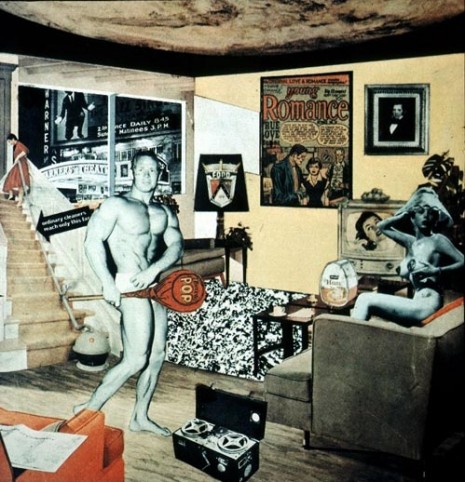
His own small, dense, prophetic work Just What Is It That Makes Today’s Homes So Different, So Appealing? not only introduced the word “pop” into art (emblazoned on the muscleman’s phallic lollipop) but also anticipated many of the key images of the genre: the television; the Warner Bros billboard; the comic poster (Lichtenstein); the packaged ham (Rosenquist); the Motel bed (Oldenburg); and the Ford logo — Hamilton’s obsession with car design and engineering culminated in Hommage à Chrysler (1957). This was Pop Art, but not populist art. Hamilton called it “a new landscape of secondary, filtered material” – sophisticated art to be devoured by a mass audience.
The exhibition’s success gained him a teaching post at the Royal College of Art, where he influenced David Hockney and Peter Blake. He produced works such as Hers Is A Lush Situation (1958), in which automotive and female design are commingled; Pin-up (1961), with its mixed idioms, classical, modern, vulgar; and the sketchy, painterly collage-like rapture of $he (1962) – it was, he suggested, “a sieved reflection of the adman’s paraphrase of the consumer’s dream”.
In 1962, Hamilton’s wife, Terry, was tragically killed in a automobile accident. Hamilton quit Britain for the USA, where he became close friends with Marcel Duchamp. The friendship led to Hamilton curating a retrospective of Duchamp’s work at the Tate Gallery, London.
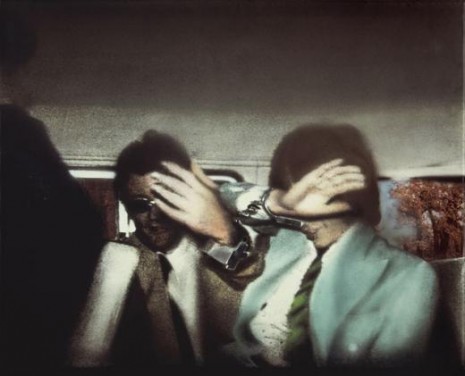
The association with Pop Art, led Hamilton to be hailed the “Father of Pop Art” a title he loathed. The association continued in the mid-sixties after he returned to England, and produced two of his most famous works Swingeing London 67, a portrait of Mick Jagger and Robert Fraser under arrest, which became one of the defining images of the 1960s. The following year Hamilton designed the cover for the Beatles White Album, which became his best known work.
The sixties also saw Hamilton influence another, younger generation of artists and musicians, most famously one of his pupils, Bryan Ferry and his band Roxy Music.
In the the 1970s, Hamilton had retrospectives at the Tate (1970) and the Guggenheim in New York (1973), both exhibitions subsequently toured Europe.
I saw one retrospective of his work during this decade at the Gallery of Modern Art in Edinburgh, which mixed his famous line drawings for James Joyce’s Ulysses, with his Pop Art, and silk screens. It was highly impressive, but more because of the intelligence on display, rather than any shared emotion inspired by the work. This may explain why Hamilton never really made the cross-over from critical acclaim to populist success.
The seventies saw Hamilton produce some of his most political work:
Hamilton had always been politically engaged, vociferously supporting the CND. In the 1980s he began a “Northern Ireland” trilogy: The Citizen (1981-83) depicted a “dirty protest” prisoner in the Maze; The Subject (1988-89), a self-righteous Orangeman; and The State (1993), a British soldier on patrol. Inevitably such politicised subject matter attracted criticism, though many considered the works merely naive oversimplifications.
Despite his advancing years, Hamilton continued to reinvent himself. In the 1980s he began working with computers: “I initially ventured into working with computers because I didn’t want to get left behind. I was approaching old age and aware of it, and I thought ‘I’m going to keep up with this’ and found out that I was ahead of everybody.” He designed two computers, the OHIO and the Diab DS-101, and increasingly used digital devices to manipulate images and create a dialogue between technique, technology and aesthetics.
The attraction of computers, he claimed, was that “you have the possibility of perfection. I’m after beauty — of composition, colour and tone.” It did not seem ironic that a man in his eighth decade was exploring technology with greater vivacity than almost any other artist: throughout his long career, Hamilton’s work anticipated almost every interpretative cultural theory, from Marshall McLuhan to the “Young British Artists”, and provided the most thorough engagement with mass media and technology this side of the Atlantic. Damien Hirst referred to Hamilton as “the greatest”.
Hamilton was appointed Companion of Honour in 2000; in 2006 he received the Max Beckmann Prize for Painting. A major retrospective of his work is due to travel to tour America and Europe from 2013.
Richard Hamilton married Terry O’Reilly in 1947; they had a son and a daughter. Rita Donagh, whom he married in 1991, survives him with the son of his first marriage.