Alejandro Jodorowsky: The Way of Tarot
02.07.2010
11:17 am

Topics:
Books

Tags:

image

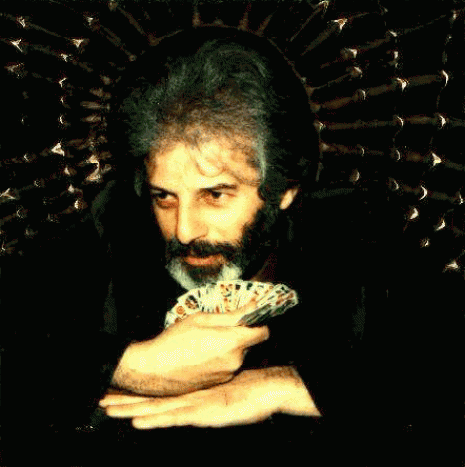
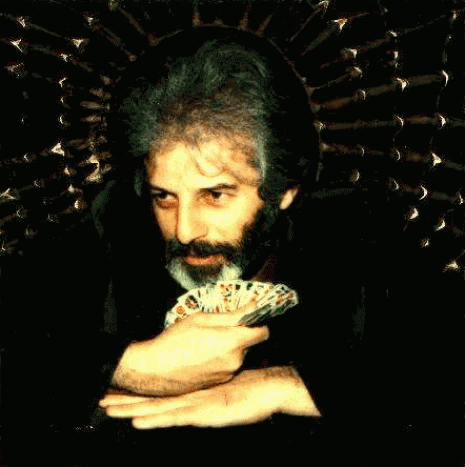
Alejandro Jodorowsky—well known to readers of this site as the director of El Topo, Santa Sangre, The Holy Mountain and several other film reels of symbolic dementia, is also one of the world’s most recognized experts on the Tarot, which he has studied as a tool of self-exploration and transformation for almost 60 years. Destiny Books just released the English translation of his 500-page magnum opus The Way of Tarot, which summarizes his work with the cards. Interestingly, Jodorowsky works with the old European deck—the Marseilles Tarot—which far predates the more commonly used Rider-Waite or Thoth packs. Looks like absolutely essential reading for fans of the man and the tarot alike.

From the promo copy:

Alejandro Jodorowsky’s profound study of the Tarot, which began in the early 1950s, reveals it to be far more than a simple divination device. The Tarot is first and foremost a powerful instrument of self-knowledge and a representation of the structure of the soul.

The Way of Tarot shows that the entire deck is structured like a temple, or a mandala, which is both an image of the world and a representation of the divine. The authors use the sacred art of the original Marseille Tarot—created during a time of religious tolerance in the 11th century—to reconnect with the roots of the Tarot’s Western esoteric wisdom. They explain that the Tarot is a “nomadic cathedral” whose parts—the 78 cards or “arcana”—should always be viewed with an awareness of the whole structure. This understanding is essential to fully grasp the Tarot’s hermetic symbolism.

The authors explore the secret associations behind the hierarchy of the cards and the correspondences between the suits and energies within human beings. Each description of the Major Arcana includes key word summaries, symbolic meanings, traditional interpretations, and a section where the card speaks for itself. Jodorowsky and Costa then take the art of reading the Tarot to a depth never before possible. Using their work with Tarology, a new psychological approach that uses the symbolism and optical language of the Tarot to create a mirror image of the personality, they offer a powerful tool for self-realization, creativity, and healing.

(Read an excerpt here.)

(The Way of Tarot: The Spiritual Teacher in the Cards)

Posted by Jason Louv | 5 Comments
Comments:
Feb 07, 2010
Stacey says:

Boy, I’ve sure been waiting for this.  Even considered attempting to read the Spanish version at one point.  Promises to be the best writing on the topic.  I just ordered three copies, one for me and more for friends.  All hail Jodorowsky!

Feb 07, 2010
Darko says:

I don’t know about Tarot, but I sure am feeling strangely compelled to buy men’s apparel all of a sudden.  Hey, look, 70% off!

Feb 09, 2010
Trelek Taus says:

Jodorowsky’s work on the tarot is an essential experience. I was in the process of translating the spanish version until I found out it was being released in english. Two important points: those who read the cards upside-down and/or attempt to predict the future are missing the left-to-right narrative and/or the whole point. I hope Dangerous Minds is working on an interview with Brother Jodo.
P.S. All other english readers should also look for “The Spiritual Journey of…” now available from Park Street Press.

Feb 09, 2010
Kate says:

AdBlock Plus is one helluva drug.

Apr 15, 2010
Allen says:

Someone made a comment regarding his latest book on a Yahoo! Group I’m a member of and I include some of the discussion, here:

When you say “several enjoyable, enlightening, and
informative little bits” are you damning it by faint praise?

I’m going to “visit” this book at Barnes & Noble this evening. Some of
the description you gave sounds fanciful, much of it sounds like things we’ve seen before.

I have read 219 of the 535 pages and i still have found several enjoyable,
enlightening, and informative little bits throughout. First he has an
introduction to the entire work. Then he moves into sections which each have
an opening chapter and then chapters addressing that sections topic.

The first section deals with his framework or basis of interpretation (how
he orients the information by place on the card, his take on tarot and
numerology, the tarot mandala he constructed as a visual “map”, and how he
interprets the 11 colors he uses in his TdeM deck.

The second section addresses the Major Arcana. With each of the majors he
begins by pointing out the imagery in the cards and gives his interpretation
using the framework described above (the orientation of the figures, the
color, their numerology, their place in the mandala, ...). He also gives a
little section of Key Words and each card also has a column of key imagery
from the card on the edge of one of that chapters pages. A section also
appears for how one could interpret the card within a reading and a seperate
section of traditional interpretation key words. The final section of each
card chapter has the voice of the card. For example, i give here a paragraph
from the nameless arcana (XIII, traditionally Death):

“Children cannot imagine me. If they did, they would stop being children,
for I am the end of childhood. Those who recognize me on their path become
adults. They know that they belong to me. I devour their difficulties, their
triumphs, their failures, their loves, their disappointments, their
pleasures, their pains, their parents, their children, their pride, their
illusions, their wealth. I devour everything. My voraciousness is boundless.
I even devour the gods. But when I reach the last of them, the authentic
one, once the masks dissolve in my entrails, I break my teeth on him. In his
indescribable mystery, in his absent presence, in his present absence, I
kill myself ... I only swallow egos. Each has a different taste, each one
more bitter and fetid than the last.”

I have read through Arcane XV. The next section covers the Minor Arcana. The
fourth section covers the cards again as they relate to the mandala he
constructed and the last section deals with card reading spreads and
techniques. The book contains some full color pages that include a picture
of each of the Majors, the courts, a couple of pips and his tarot mandala.

Page 1 of 1
Create a Comment

Name:

Email:

Location:

Smileys

Remember my personal information

Notify me of follow-up comments?

Submit the word you see below: