Occupy Your Rage Against the Machine: Bill Moyers interviews Tom Morello


Bill Moyers continues to make astonishing television with his truly great new PBS series, Moyers and Company. It’s unmissable, the most intelligent hour of programming on American TV today, bar none.

In the latest episode, Rage Against The Machine’s Tom Morello—a man I have a lot of admiration for—joined Bill Moyers for a particularly moving and inspiring conversation. From the show’s website

Songs of social protest—music and the quest for justice—have long been intertwined, and the troubadours of troubling times—Guthrie, Seeger, Baez, Dylan, and Springsteen among them—have become famous for their dedication to both. Now we can add a name to the ranks of those who lift their voices for social and economic justice: Tom Morello.

Morello is the Harvard-educated guitarist who dabbled in politics, then chose rock music to make a difference. He played guitar for the popular band he co-founded—Rage Against the Machine—and then for Audioslave. Rolling Stone chose his album “World Wide Rebel Songs” as one of the best of 2011, and named him one of the 100 greatest guitarists of all time.

As likely to be spotted at a grass-roots rally as he would at a concert hall, Morello was in Madison, Wisconsin last year, braving bitter winter weather to sing on the steps on the state capitol in support of public service workers. Morello defended their collective bargaining rights against Republican Governor Scott Walker.

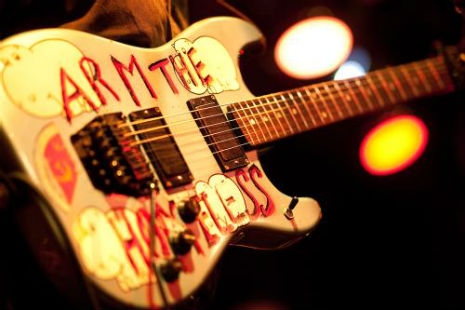
He was in New York City at the May Day demonstrations, an honorary commander of a battalion of musicians they called the “Occupy Guitarmy.” That same night, Harry Belafonte presented Morello with the Officers’ Award from the Sidney Hillman Foundation, honoring his “advocacy for and support of working people across the world.”

Tom Morello shares his music, his message, and mission with Bill Moyers, who’s all ears.

Two badass motherfuckers in conversation….
 

Written by Richard Metzger | Comments
Occupy the entire city: Global Revolution TV’s live feed from NYC


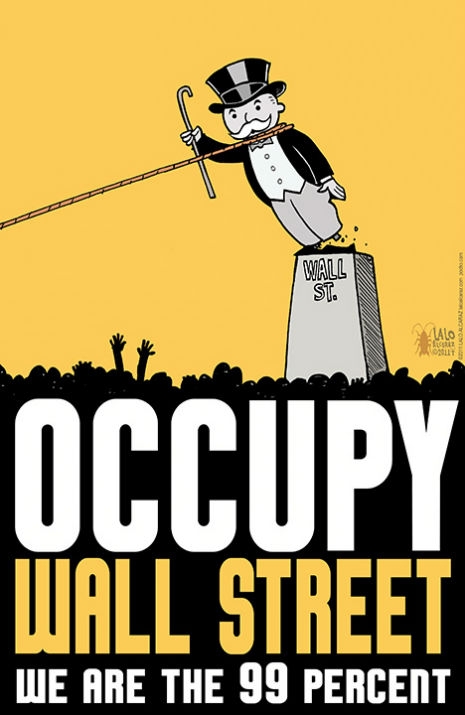
Occupy Wall Street poster by Lalo Alcaraz

Some pretty amazing images turning up on this live feed. How much of this is anyone seeing via the major media outlets? Other than The Guardian’s coverage, I ain’t seeing much at all.
 

Watch live streaming video from globalrevolution at livestream.com
Written by Richard Metzger | Comments
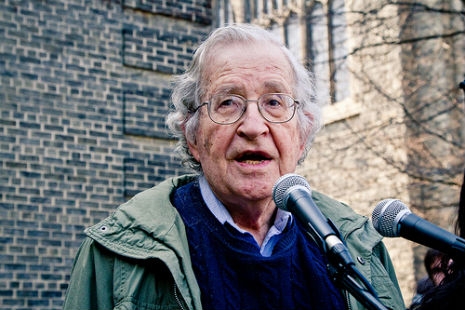
Noam Chomsky: Where does Occupy go from here


This is the transcript of a discussion that took place earlier this year between Noam Chomsky and Occupy supporters Mikal Kamil and Ian Escuela for InterOccupy, an organisation that provides links between supporters of the Occupy movement around the world.

Professor Chomsky, the Occupy movement is in its second phase. Three of our main goals are to: 1) occupy the mainstream and transition from the tents and into the hearts and the minds of the masses; 2) block the repression of the movement by protecting the right of the 99%‘s freedom of assembly and right to speak without being violently attacked; and 3) end corporate personhood. The three goals overlap and are interdependent.

We are interested in learning what your position is on mainstream filtering, the repression of civil liberties, and the role of money and politics as they relate to Occupy and the future of America.

Noam Chomsky: Coverage of Occupy has been mixed. At first it was dismissive, making fun of people involved as if they were just silly kids playing games and so on. But coverage changed. In fact, one of the really remarkable and almost spectacular successes of the Occupy movement is that it has simply changed the entire framework of discussion of many issues. There were things that were sort of known, but in the margins, hidden, which are now right up front – such as the imagery of the 99% and 1%; and the dramatic facts of sharply rising inequality over the past roughly 30 years, with wealth being concentrated in actually a small fraction of 1% of the population.

For the majority, real incomes have pretty much stagnated, sometimes declined. Benefits have also declined and work hours have gone up, and so on. It’s not third world misery, but it’s not what it ought to be in a rich society, the richest in the world, in fact, with plenty of wealth around, which people can see, just not in their pockets.

All of this has now been brought to the fore. You can say that it’s now almost a standard framework of discussion. Even the terminology is accepted. That’s a big shift.

Earlier this month, the Pew foundation released one of its annual polls surveying what people think is the greatest source of tension and conflict in American life. For the first time ever, concern over income inequality was way at the top. It’s not that the poll measured income inequality itself, but the degree to which public recognition, comprehension and understanding of the issue has gone up. That’s a tribute to the Occupy movement, which put this strikingly critical fact of modern life on the agenda so that people who may have known of it from their own personal experience see that they are not alone, that this is all of us. In fact, the US is off the spectrum on this. The inequalities have risen to historically unprecedented heights. In the words of the report: “The Occupy Wall Street movement no longer occupies Wall Street, but the issue of class conflict has captured a growing share of the national consciousness. A new Pew Research Center survey of 2,048 adults finds that about two-thirds of the public (66%) believes there are “very strong” or “strong” conflicts between the rich and the poor – an increase of 19 percentage points since 2009.”

Meanwhile, coverage of the Occupy movement itself has been varied. In some places – for example, parts of the business press – there has been fairly sympathetic coverage occasionally. Of course, the general picture has been: “Why don’t they go home and let us get on with our work?” “Where is their political programme?” “How do they fit into the mainstream structure of how things are supposed to change?” And so on.

And then came the repression, which of course was inevitable. It was pretty clearly coordinated across the country. Some of it was brutal, other places less so, and there has been kind of a stand-off. Some occupations have, in effect, been removed. Others have filtered back in some other form. Some of the things have been covered, like the use of pepper spray, and so on. But a lot of it, again, is just, “Why don’t they go away and leave us alone?” That’s to be anticipated.

The question of how to respond to it – the primary way is one of the points that you made: reaching out to bring into the general Occupation, in a metaphorical sense, to bring in much wider sectors of the population. There is a lot of sympathy for the goals and aims of the Occupy movement. They are quite high in polls, in fact. But that’s a big step short from engaging people in it. It has to become part of their lives, something they think they can do something about. So it’s necessary to get out to where people live. That means not just sending a message, but if possible, and it would be hard, to try to spread and deepen one of the real achievements of the movement that doesn’t get discussed much in the media – at least, I haven’t seen it. One of the main achievements has been to create communities – real functioning communities of mutual support, democratic interchange, care for one another, and so on. This is highly significant, especially in a society like ours in which people tend to be very isolated and neighbourhoods are broken down, community structures have broken down, people are kind of alone.

There’s an ideology that takes a lot of effort to implant: it’s so inhuman that it’s hard to get into people’s heads, the ideology to just take care of yourself and forget about anyone else. An extreme version is the Ayn Rand version. Actually, there has been an effort for 150 years, literally, to try to impose that way of thinking on people.

During the onset of the industrial revolution in eastern Massachusetts, mid-19th century, there happened to be a very lively press run by working people, young women in the factories, artisans in the mills, and so on. They had their own press that was very interesting, very widely read and had a lot of support. And they bitterly condemned the way the industrial system was taking away their freedom and liberty and imposing on them rigid hierarchical structures that they didn’t want. One of their main complaints was what they called “the new spirit of the age: gain wealth forgetting all but self”. For 150 years there have been massive efforts to try to impose “the new spirit of the age” on people. But it’s so inhuman that there’s a lot of resistance, and it continues.

One of the real achievements of the Occupy movement, I think, has been to develop a real manifestation of rejection of this in a very striking way. The people involved are not in it for themselves. They’re in it for one another, for the broader society and for future generations. The bonds and associations being formed, if they can persist and if they can be brought into the wider community, would be the real defence against the inevitable repression with its sometimes violent manifestations.

How best do you think the Occupy movement should go about engaging in these, what methods should be employed, and do you think it would be prudent to actually have space to decentralise bases of operation?

Noam Chomsky: It would certainly make sense to have spaces, whether they should be open public spaces or not. To what extent they should be is a kind of a tactical decision that has to be made on the basis of a close evaluation of circumstances, the degree of support, the degree of opposition. They’re different for different places, and I don’t know of any general statement.

As for methods, people in this country have problems and concerns, and if they can be helped to feel that these problems and concerns are part of a broader movement of people who support them and who they support, well then it can take off. There is no single way of doing it. There is no one answer.

You might go into a neighbourhood and find that their concerns may be as simple as a traffic light on the street where kids cross to go to school. Or maybe their concerns are to prevent people from being tossed out of their homes on foreclosures.

Or maybe it’s to try to develop community-based enterprises, which are not at all inconceivable – enterprises owned and managed by the workforce and the community which can then overcome the choice of some remote multinational and board of directors made out of banks to shift production somewhere else. These are real, very live issues happening all the time. And it can be done. Actually, a lot of it is being done in scattered ways.

A whole range of other things can be done, such as addressing police brutality and civic corruption. The reconstruction of media so that it comes right out of the communities, is perfectly possible. People can have a live media system that’s community-based, ethnic-based, labour-based and [reflecting] other groupings. All of that can be done. It takes work and it can bring people together.

Actually, I’ve seen things done in various places that are models of what could be followed. I’ll give you an example. I happened to be in Brazil a couple of years ago and I was spending some time with Lula, the former president of Brazil, but this was before he was elected president. He was a labour activist. We travelled around together. One day he took me out to a suburb of Rio. The suburbs of Brazil are where most of the poor people live.

They have semi-tropical weather there, and the evening Lula took me out there were a lot of people in the public square. Around 9pm, prime TV time, a small group of media professionals from the town had set up a truck in the middle of the square. Their truck had a TV screen above it that presented skits and plays written and acted by people in the community. Some of them were for fun, but others addressed serious issues such as debt and Aids. As people gathered in the square, the actors walked around with microphones asking people to comment on the material that had been presented. They were filmed commenting and were shown on the screen for other people to see it.

People sitting in a small bar nearby or walking in the streets began reacting, and in no time you had interesting interchanges and discussions among people about quite serious topics, topics that are part of their lives.

Well, if it can be done in a poor Brazilian slum, we can certainly do it in many other places. I’m not suggesting we do just that, but these are the kinds of things that can be done to engage broader sectors and give people a reason to feel that they can be a part of the formation of communities and the development of serious programmes adapted to whatever the serious needs happen to be.

From very simple things up to starting a new socio-economic system with worker- and community-run enterprises, a whole range of things is possible. The more active public support there is the better defence there is against repression and violence.

How do you assess the goals of the Democratic party as far as co-opting the movement, and what should we be vigilant and looking out for?

Noam Chomsky: The Republican party abandoned the pretence of being a political party years ago. They are committed, so uniformly and with such dedication, to tiny sectors of power and profit that they’re hardly a political party any more. They have a catechism they have to repeat like a caricature of the old Communist party. They have to do something to get a voting constituency. Of course, they can’t get it from the 1%, to use the imagery, so they have been mobilising sectors of the population that were always there, but not politically organised very well – religious evangelicals, nativists who are terrified that their rights and country are being taken away, and so on.

The Democrats are a little bit different and have different constituencies, but they are following pretty much the same path as the Republicans. The centrist Democrats of today, the ones who essentially run the party, are pretty much the moderate Republicans of a generation ago and they are now kind of the mainstream of the Democrat party. They are going to try to organise and mobilise – co-opt, if you like – the constituency that’s in their interest. They have pretty much abandoned the white working-class; it’s rather striking to see. So that’s barely part of their constituency at this point, which is a pretty sad development. They will try to mobilise Hispanics, blacks and progressives. They’ll try to reach out to the Occupy movement.

Organised labour is still part of the Democratic constituency and they’ll try to co-opt them; and with Occupy, it’s just the same as all the others. The political leadership will pat them on the head and say: “I’m for you, vote for me.” The people involved will have to understand that maybe they’ll do something for you, that only if you maintain substantial pressure can you get elected leadership to do things – but they are not going to do it on their own, with very rare exceptions.

As far as money and politics are concerned, it’s hard to beat the comment of the great political financier Mark Hanna. About a century ago, he was asked what was important in politics. He answered: “The first is money, the second one is money and I’ve forgotten what the third one is.”

That was a century ago. Today it’s much more extreme. So yes, concentrated wealth will, of course, try to use its wealth and power to take over the political system as much as possible, and to run it and do what it wants, etc. The public has to find ways to struggle against that.

Centuries ago, political theorists such as David Hume, in one of his foundations for government, pointed out correctly that power is in the hands of the governed and not the governors. This is true for a feudal society, a military state or a parliamentary democracy. Power is in the hands of the governed. The only way the rulers can overcome that is by control of opinions and attitudes.

Hume was right in the mid-18th century. What he said remains true today. The power is in the hands of the general population. There are massive efforts to control it by less force today because of the many rights that have been won. Methods now are by propaganda, consumerism, stirring up ethnic hatred, all kinds of ways. Sure, that will always go on but we have to find ways to resist it.

There is nothing wrong with giving tentative support to a particular candidate as long as that person is doing what you want. But it would be a more democratic society if we could also recall them without a huge effort. There are other ways of pressuring candidates. There is a fine line between doing that and being co-opted, mobilised to serve someone else’s interest. But those are just constant decisions and choices that have to be made.

Extracted from Occupy by Noam Chomsky, published by the Zuccotti Park Press and the Occupied Media Pamphlet Series in the US and Canada.

Written by Richard Metzger | Comments
NYPD raided Occupy activists’ homes night before May Day protests


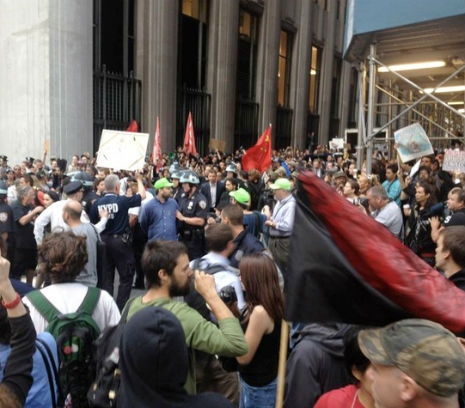
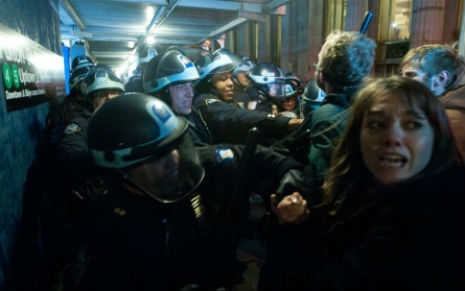
NYPD have a “discussion” with OWS protesters in 2011

Last night, several Occupy Wall Street activists were paid a visit at their homes by the NYPD who wanted to inquire about the activities they had planned for today’s mass protests. Gawker’s Adrian Chen reports that Gideon Oliver, the New York Chapter of the National Lawyers Guild’s president, told him, “They were asking what are your May Day plans, do you know who the leaders are—these are classic political surveillance questions.”

In the first case: activist Zachary Dempster said that six NYPD officers broke down the door of his Bushwick, Brooklyn apartment at around 6:15am this morning. Dempster said they were armed with a warrant for the arrest of his roommate, musician Joe Crow Ryan, for a six-year-old open container violation. But Dempster believes this was an excuse to check in on him, as he’d been arrested in February at an Occupy Wall Street Party that was broken up by cops, and charged with assaulting a police office and inciting a riot.

WTF? SIX COPS knocked this guy’s fucking door down for a SIX-YEAR-OLD OPEN CONTAINER VIOLATION??? Talk about a flimsy excuse for a SIX COP RAID!

They got a warrant and broke a door down because of a 2006 misdemeanor? (Or is it merely an infraction?) Remarkable!

That will teach that Communist hippie about cracking open a beer in public!

That they were able to secure a warrant to break the door down is something I hope to hear Mayor Bloomberg forced to explain…

After running his ID, a detective questioned Dempster in his bedroom for about five minutes about tomorrow’s May Day protest, he said.

“They asked what I was doing tomorrow, and if I knew of any activities, any events—that was how the conversation started,” Dempster said. Dempster said he’s not planning doing much, as his case from February is still open. Dempster’s roommate was also asked about him and May Day.

About an hour later, an activist friend of Dempster’s who runs in anarchist circles said his apartment in Bed-Stuy, Brooklyn, where he lives with a half-dozen other activists and Occupy Wall Street organizers was visited by six NYPD cops—possibly the same ones. The activist said police used arrest warrants for two men who no longer lived there as pretext for the raid. The officers ran the IDs of everyone who was in the apartment, then booked our source when they discovered he had an outstanding open container violation. Police never asked about Occupy Wall Street or May Day, but our source said the message was clear: We’re watching you.

Another open container violation? This is real “my dog ate my homework” shit, isn’t it? Open container violations! Imagine having your door knocked down by six police officers for a jay-walking ticket you didn’t pay.

“We obviously don’t think it’s an accident that it happened the day before May Day, where people in the house are organizers,” he said.

This afternoon, NYPD also visited the home of Greek anarchist artist Georgia Sagri, who has been part of Occupy Wall Street from the beginning and led the occupation of a SoHo art gallery last October. Turns out she was giving a press conference about May Day at Zuccotti Park at the time. Police waited for about an hour outside her home, then left.

“My roommate gave me a call and told me the NYPD was looking for me,” Sagri said. “Since that time, I didn’t go home. So I’m basically on the street. My May Day has already started which is fine, I don’t mind.” She said she has no idea why NYPD visited her.

This isn’t the first time NYPD has been criticized for aggressive surveillance of protesters: The NYPD infiltrated activist groups around the country before 2004’s New York Ciy Republican National Convention. And The New York Times has ably detailed the extent to which NYPD has harassed and spied on Occupy Wall Street protesters.

“The intention behind this I’m sure is to try to create fear and silence dissent,” said Marina Sitrin, a lawyer and member of Occupy Wall Street’s legal working group, “and to keep people from coming out into the streets.”

There are several marches, blockades and acts of civil disobedience planned across New York City today. From what I can tell via what precocious few media reports there have been, the rain is ending in the city and the protests are now starting to really gear up in Times Square, in front of Fox News and in the business district. If you can’t support the actions because you can’t get out of work, there is a mass rally expected in lower Manhattan after the work day.

Interesting to note (and I’m basing this observation from sampling through the live “Occupy Wall Street Superchannel” at UStream) the protests this time are more diffuse and spread out all over New York. Whereas it may not make for the same sort of TV-ready drama that attempts to close the Brooklyn Bridge off did last year, it makes the NYPD’s job a lot harder. You can “bottle,” contain and squeeze a large group, but it’s much harder to do anything about hundred of sites happening at once. Nice to see that the tactics are evolving.

Written by Richard Metzger | Comments
General Strike. No Work. No Shopping. Occupy Everywhere


Marxist anthropologist David Harvey talks to Democracy Now’s Amy Goodman about what to expect during tomorrow’s May Day protests.

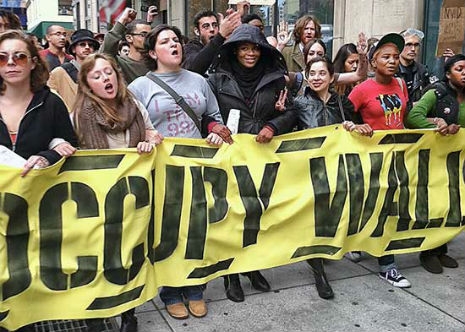
On Tuesday, May 1st, known as May Day or International Workers Day, Occupy Wall Street protesters hope to mobilize tens of thousands of people across the country under the slogan, “General Strike. No Work. No Shopping. Occupy Everywhere.” Events are planned in 125 cities. We speak with leading social theorist David Harvey, distinguished professor of anthropology at the Graduate Center of the City University of New York, about how Occupy Wall Street compares to other large-scale grassroots movements throughout modern history.

“It’s struck a chord,” Harvey says of the Occupy movement. “I hope tomorrow there’ll be a situation in which many more people will say, ‘Look, things have got to change. Something different has to happen.’”

David Harvey’s latest book is Rebel Cities: From the Right to the City to the Urban Revolution.


Via Alternet

Written by Richard Metzger | Comments
‘We’re the official OWS group!’ ‘No, we’re the official OWS group!’ and so forth


This is (almost) funny: So the upcoming OWS convention in Philly that we’ve been reading about all day? Another OWS group is publicly countering the legitimacy of that group now, claiming that the so-called 99% Declaration Group is not endorsed by the “official” group and blah blah blah blah blah blah blah.

What a bunch of pompous crybabies. Who gives a fuck? No one owns this movement. They can do it in their way, in their style and you can do it in your own way. Why try to hold this energy back in any way? What’s the point, you’re not on the same side?

Stop being such predictable Lefties!

Play nice! Thelemites get along better than these territorial children!

OWS PR working group statement on the 99% Declaration:

The 99% Declaration and its call for a “national general assembly” in Philadelphia in July is not affiliated with or endorsed by Occupy Wall Street, and the organizers’ plans blatantly contradict OWS’ stated principles.

Many news outlets are running articles suggesting that the Occupy movement is planning a “national general assembly” in Philadelphia in July. This initiative, referred to as The 99% Declaration, is driven by a not-for-profit corporation called The 99 Percent Working Group, LTD., and is not endorsed by the General Assembly at Occupy Wall Street (OWS). The group’s plans blatantly contradict OWS’ Statement of Autonomy, as passed by the General Assembly at Occupy Wall Street, where The 99% Declaration generated more controversy than consensus. The proposal was also rejected by the General Assembly of Occupy Philadelphia, which passed a resolution stating, “We do not support the 99% Declaration, its group, its website, its National GA and anything else associated with it.”

The people of Occupy Wall Street are doubtlessly animated by many of the same concerns addressed by the points in the draft 99% Declaration. However, the group’s plan to select delegates representing each Congressional District to ratify a petition to present to the U.S. government while threatening to run candidates for positions in this corrupted system runs counter to OWS’ commitment to direct democracy, grassroots people power, and building a better society from the bottom up.

When reporting on stories concerning the convening of national ‘Occupy conventions,’ registration of political parties and political action committees, and other high-profile initiatives, we strongly urge reporters, editors, and producers to vet these stories by contacting the official press relations working group of Occupy Wall Street.

From OWS’ Statement of Autonomy:  “Any statement or declaration not released through the General Assembly and made public online at www.nycga.net should be considered independent of Occupy Wall Street.”

The Press Relations Working Group of Occupy Wall Street
.(JavaScript must be enabled to view this email address)
347-292-1444

LAME!

Written by Richard Metzger | Comments
Occupy Wall Street will elect delegates, hold July convention in Philly


An Associated Press report today about the latest stirrings of the Occupy movement indicates that this Summer is going to be a hot one indeed, for both Republicans and Democrats alike.

A group of protesters affiliated with the Occupy Wall Street movement plans to elect 876 “delegates” from around the country and hold a national “general assembly” in Philadelphia over the Fourth of July as part of ongoing protests over corporate excess and economic inequality.The group, dubbed the 99% Declaration Working Group, said Wednesday delegates would be selected during a secure online election in early June from all 50 states, the District of Columbia and U.S. territories.

In a nod to their First Amendment rights, delegates will meet in Philadelphia to draft and ratify a “petition for a redress of grievances,” convening during the week of July 2 and holding a news conference in front of Independence Hall on the Fourth of July.

Any U.S. citizen or lawful permanent resident who is 18 years of age or older may run as a nonpartisan candidate for delegate, according to Michael S. Pollok, an attorney who advised Occupy Wall Street protesters arrested on the Brooklyn Bridge last year and co-founded the working group.

“We feel it’s appropriate to go back to what our founding fathers did and have another petition congress,” Pollok said in an interview with The Associated Press. “We feel that following the footsteps of our founding fathers is the right way to go.”

In 1776, the Declaration of Independence was adopted by the Continental Congress in Philadelphia and cited King George III’s failure to redress the grievances listed in colonial petitions as a reason to declare independence.

Interesting that the OWS iconography is now dovetailing with the Tea party movement in a congruence that I can’t decide seems forced or organic. I don’t think it’s a bad thing. In Bill Moyers’ fascinating interview with former Ronald Reagan economic adviser Bruce Bartlett, Bartlett expressed his prediction that a lot of former Tea partiers might come to decide that the OWS aims were more in tune with their actual beliefs.

One man and one woman will be elected from each of the 435 congressional voting districts, according to Pollok, and they will meet in Philadelphia to deliberate, draft and ratify a “redress of grievances.” One delegate will also be elected to represent each of the U.S. territories.

Organizers won’t take a position on what grievances should be included, Pollok said, but they will likely include issues like getting money out of politics, dealing with the foreclosure crisis and helping students handle loan debt.

Details of the conference are still being worked out, Pollok said, but organizers have paid for a venue in Philadelphia. Pollok would not identify the venue, but said it was “a major state-of-the art facility.” Pollok said the group planned to pay for the conference through donations.

Once the petition is completed, Pollok said, the protesters will deliver copies to the White House, members of Congress and the Supreme Court. They will demand that Congress takes action in the first 100 days of taking office next year. If sufficient action isn’t taken, Pollok said, the delegates will go back to their districts and try to recruit their own candidates for office.

Being able to hold this event right before the parties throw their respective conventions was a stroke of scheduling luck for the movement. Hopefully the media will be all over this—it’s hard to imagine they wouldn’t be under any circumstances—and the politicians will be forced to respond.

The Republicans are beyond being a lost cause, but the Democrats can be pushed to the left (it’s what happened before the New Deal). It will be very interesting to see how this plays out.

I think there’s a misconception that this was going to be a predictable election cycle. Whereas the outcome (more Obama, not that this is necessarily a “good” thing, it just is) seems like a foregone covclusion, that there will be extremely high drama until then is starting to look like an inevitability. Bring it on.
 

Written by Richard Metzger | Comments
F**KED: The United States of Unemployment


Salon’s got a great series of videos exploring the lives and coping strategies of “the 99ers”—no, not the 99%, although they are certainly a part of that, too—the people who have exhausted 99 weeks of unemployment insurance and have nowhere else to turn.

In this most recent installment, Oscar-nominated documentary filmmaker Immy Humes listens to members of the longtime unemployed tell how the Occupy movement inspired them. There is something in the emotional core of this short film that captures perfectly, I think, the life-affirming realization of “Holy shit, this is really happening and it’s wonderful” that went on for those few months last Fall. Almost more than any other document I’ve seen about Occupy Wall Street, this one really speaks to the kind of experience I personally had there. It captures what it inspired in many people.

For our 99ers, an informal group of jobless New Yorkers who have exhausted their 99 weeks of unemployment benefits, the Occupy Wall Street movement came as a dream fulfilled.

As the protests took root in Zuccotti Park, the 99ers found a mass of people who care about the plight of the jobless and want to do something about it. As seen in last week’s episode of our video series, “Occupy Meets MacArthur’s Tanks,” Occupy Wall Street is just the latest in a long line of American protest movements demanding economic justice. The emergence of the Occupy movement, one 99er said, felt “like the early stages of a revolution.”

And then the question arose: What do America’s jobless want? As the video shows, the 99ers have some answers.


Written by Richard Metzger | Comments
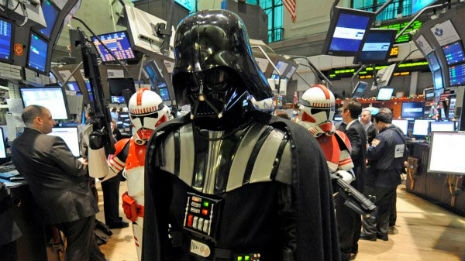
Rebel Alliance takes on Goldman Vader: Occupy the SEC!


In a Mother Jones piece that is starting to gain traction across the liberal blogsphere today, Josh Harkinson writes about the Occupy the SEC group that includes “financial insiders with the education and regulatory vocabulary to challenge high-powered lobbyists at their own game.”

Yesterday, a group affiliated with Occupy Wall Street submitted an astounding comment letter to the Securities and Exchange Commission. Point by point, it methodically challenges the arguments of finance industry lobbyists who want to water down last year’s historic Dodd-Frank Wall Street reforms. The lobbyists have been using the law’s official public comment period to try to kneecap the reforms, and given how arcane financial regulation can be, they might get away with it. But Occupy the SEC is fighting fire with fire, and in so doing, defying stereotypes of the Occupy movement.

The financial industry is trying desperately to wriggle out of the controls that Dodd-Frank imposed on them. Occupy the SEC, a very, very smart bunch of current and former financial industry executives weigh in with critiques and suggestions concerning the government’s implementation of the “Volcker Rule” that limits the kind of derivative packaging that caused the financial meltdown. Since the meltdown, Goldman Sachs has been trying to get their little grubby hands back on the money faucet.  They’re spending Romney-type money on lobbyists, including hiring Barney Frank’s former staffer that got the reforms passed to help overturn those very reforms!

The most common complaint about the Occupy movement is that it does not present a clear and coherent position.

This 324-page letter blows that contention sky-high.

“Occupy the SEC is a group of concerned citizens, activists, and financial professionals with decades of collective experience working at many of the largest financial firms in the industry. Together, we make up a vast array of specialists, including traders, quantitative analysts, compliance officers, and technology and risk analysts. Like much of the 99%, we have bank deposits and retirement accounts that are in need of protection through vigorous enforcement of the Volcker Rule. Our experiences working inside the financial industry have informed our answers to the questions proposed, making us well-suited to understand and anticipate how the proposed implementation, should it stand, will affect us and the rest of the general public.

The United States aspires to democracy, but no true democracy is attainable when the process is determined by economic power…”

That last sentence should be the first line of the Declaration of Independence 2.0

Here’s the best mainstream overview, from TIME. If you read between the lines—and the wipe off its condescension—the truth appears… which is that the fuckers at Goldman Sachs and the champagne drinking overlords on Wall Street are being countered by experienced folks who know the financial industry grimoire inside and out.

Meet the Financial Wizards Working With Occupy Wall Street (Mother Jones)

Written by Richard Metzger | Comments
May Day: Massive protest planned for NATO and G8 summit in Chicago


Adbusters magazine, the original impetus behind the Occupy Wall Street movement, has issued a new invitation for a month-long direct action and occupation this May in the Windy City. Looks like this one could be quite a party, too:

Hey you redeemers, rebels and radicals out there,

Against the backdrop of a global uprising that is simmering in dozens of countries and thousands of cities and towns, the G8 and NATO will hold a rare simultaneous summit in Chicago this May. The world’s military and political elites, heads of state, 7,500 officials from 80 nations, and more than 2,500 journalists will be there.

And so will we.

On May 1, 50,000 people from all over the world will flock to Chicago, set up tents, kitchens, peaceful barricades and #OCCUPYCHICAGO for a month. With a bit of luck, we’ll pull off the biggest multinational occupation of a summit meeting the world has ever seen.

And this time around we’re not going to put up with the kind of police repression that happened during the Democratic National Convention protests in Chicago, 1968 … nor will we abide by any phony restrictions the City of Chicago may want to impose on our first amendment rights. We’ll go there with our heads held high and assemble for a month-long people’s summit … we’ll march and chant and sing and shout and exercise our right to tell our elected representatives what we want … the constitution will be our guide.

And when the G8 and NATO meet behind closed doors on May 19, we’ll be ready with our demands: a Robin Hood Tax … a ban on high frequency ‘flash’ trading … a binding climate change accord … a three strikes and you’re out law for corporate criminals … an all out initiative for a nuclear-free Middle East … whatever we decide in our general assemblies and in our global internet brainstorm – we the people will set the agenda for the next few years and demand our leaders carry it out.

And if they don’t listen … if they ignore us and put our demands on the back burner like they’ve done so many times before … then, with Gandhian ferocity, we’ll flashmob the streets, shut down stock exchanges, campuses, corporate headquarters and cities across the globe … we’ll make the price of doing business as usual too much to bear.

Jammers, pack your tents, muster up your courage and prepare for a big bang in Chicago this Spring. If we don’t stand up now and fight now for a different kind of future we may not have much of a future … so let’s live without dead time for a month in May and see what happens …

for the wild,
Culture Jammers HQ

Below, footage of the confrontation between Chicago police and protesters at the 1968 Democratic Convention in Chicago:


Crosby, Stills, Nash & Young’s “Chicago”:
 

Written by Richard Metzger | Comments
Visualizing Student Loan Debt
12.12.2011
03:59 pm

Topics:
Class War

Tags:
Occupy Wall Street
debt


Well, when you put it that way… Staggering isn’t it?

Worth it? Draw your own conclusions, based on your own monthly payments, but something tells me that a lot of America’s for profit universities are going to be circling the drain in coming years, as more and more young people see the writing on the wall and ask themselves, “What’s the fucking point?”

Hard work and keeping your nose to the grindstone used to be what it took to get ahead. Now what? The only assured and reasonable way to succeed in America today is to be born rich... or a sociopath!

Written by Richard Metzger | Comments
‘How else WOULD you do it?’: Thom Yorke & Massive Attack’s 3D talk #OWS


Massive Attack’s Robert ‘3D’ Del Naja and Radiohead’s Thom Yorke thoughtfully discuss the impact of the Occupy movement. Recorded outside of the Occupy London Xmas Party on December 6th, where both men DJ’d to show their appreciation for the movement’s efforts.
 

Written by Richard Metzger | Comments
Not funny: ‘Family Guy’ writer’s Occupy Los Angeles arrest story


Patrick Meighan is “a husband, a father, a writer on the Fox animated sitcom Family Guy, and a member of the Unitarian Universalist Community Church of Santa Monica.” He also was arrested by the LAPD at the Occupy Los Angele encampment at City Hall. He’s posted the story of what happened when the camp was upended and of his experiences in jail.

His conclusions about the experience are not to be missed:

Finally, at 2:30 the next morning, after twenty-five hours in custody, I was released on bail. But there were at least 200 Occupy LA protestors who couldn’t afford the bail. The LAPD chose to keep those peaceful, non-violent protesters in prison for two full days… the absolute legal maximum that the LAPD is allowed to detain someone on misdemeanor charges.

As a reminder, Antonio Villaraigosa has referred to all of this as “the LAPD’s finest hour.”

So that’s what happened to the 292 women and men were arrested last Wednesday. Now let’s talk about a man who was not arrested last Wednesday. He is former Citigroup CEO Charles Prince. Under Charles Prince, Citigroup was guilty of massive, coordinated securities fraud.

Citigroup spent years intentionally buying up every bad mortgage loan it could find, creating bad securities out of those bad loans and then selling shares in those bad securities to duped investors. And then they sometimes secretly bet *against* their *own* bad securities to make even more money. For one such bad Citigroup security, Citigroup executives were internally calling it, quote, “a collection of dogshit”. To investors, however, they called it, quote, “an attractive investment rigorously selected by an independent investment adviser”.

This is fraud, and it’s a felony, and the Charles Princes of the world spent several years doing it again and again: knowingly writing bad mortgages, and then packaging them into fraudulent securities which they then sold to suckers and then repeating the process. This is a big part of why your property values went up so fast. But then the bubble burst, and that’s why our economy is now shattered for a generation, and it’s also why your home is now underwater. Or at least mine is.

Anyway, if your retirement fund lost a decade’s-worth of gains overnight, this is why.

If your son’s middle school has added furlough days because the school district can’t afford to keep its doors open for a full school year, this is why.

If your daughter has come out of college with a degree only to discover that there are no jobs for her, this is why.

But back to Charles Prince. For his four years of in charge of massive, repeated fraud at Citigroup, he received fifty-three million dollars in salary and also received another ninety-four million dollars in stock holdings. What Charles Prince has *not* received is a pair of zipcuffs. The nerves in his thumb are fine. No cop has thrown Charles Prince into the pavement, face-first. Each and every peaceful, nonviolent Occupy LA protester arrested last week has has spent more time sleeping on a jail floor than every single Charles Prince on Wall Street, combined.

The more I think about that, the madder I get. What does it say about our country that nonviolent protesters are given the bottom of a police boot while those who steal hundreds of billions, do trillions worth of damage to our economy and shatter our social fabric for a generation are not only spared the zipcuffs but showered with rewards?

In any event, believe it or not, I’m really not angry that I got arrested. I chose to get arrested. And I’m not even angry that the mayor and the LAPD decided to give non-violent protestors like me a little extra shiv in jail (although I’m not especially grateful for it either).

I’m just really angry that every single Charles Prince wasn’t in jail with me.

My Occupy LA Arrest, by Patrick Meighan


Via Crooks and Liars

Written by Richard Metzger | Comments
A dissenting view of Occupy Wall Street from China


James Fallows posts some excerpts at The Atlantic from an essay, recently published in China, that takes issue with the way that much of the initial Chinese media coverage of Occupy Wall Street depicted the protest as, in Fallows words, “...yet another sign of America’s decadence and imminent collapse.”

Democracy clearly has its flaws, but OWS shows not the defects of democracy but its advantages. That protestors do not “go missing” [as they have this year in China] is thanks to the benefits of democracy, and the lack of violent conflict or loss of social order is an example of its accomplishments. The US government has not condemned nor suppressed, but rather sympathised* with the movement, nor have the crowds challenged the legitimacy of the government or the democratic system itself. Rather, OWS is happening precisely within that democratic framework.

In other words: we must change our perspective and see this demonstration as a rational expression of democracy, and the normal activity of a healthy society rather than the upheaval of it.

A Fascinating Chinese View of the Occupy Movement (The Atlantic)

Written by Richard Metzger | Comments
Occupy Ninjas Take Manhattan


Style is a weapon! The Occupy Ninjas are “The Blue Man Group” of political protest, making the Revolution look extremely cool.

Coming soon to a bank near YOU...


Via The Punk Patriot

Written by Richard Metzger | Comments
Page 1 of 8  1 2 3 >  Last ›